News From the Front Lines of Civic Education
Doing Civics for Civics: Modeling Civic Participation on Capitol Hill
Earlier this month, CivxNow and the National Council for the Social Studies (NCSS) took to Capitol Hill to advocate for the future of civics, social studies, and history education. More than 70 educators, students, and partners represented 15 states, holding 50+ congressional meetings in a single day to urge federal policymakers to support robust funding for civic learning.
By stepping into these offices, advocates modeled “doing civics for civics” and the kind of informed civic participation Justice Sandra Day O’Connor envisioned when she founded iCivics.
Call for Proposals: 2027 Civic Learning Week National Forum
We are now accepting session proposals for the 2027 Civic Learning Week National Forum. Co-hosted by iCivics and the John S. and James L. Knight Foundation, the 2027 National Forum to be held in Charlotte, NC, on March 11–12, 2027, will explore the theme Civic Education in the Digital Age.
We are seeking experts to lead sessions on Digital Tools in Civic Learning; How Young People Now Learn; Trust, Expertise, and Civic Institutions; and Field Adoption and Assessment.
Proposals are due Friday, September 18, 2026. An optional informational webinar with time for Q&A will be held Friday, August 28, at 11:00 a.m. Eastern.
Research Roundup: Culturally Divisive Conflict Costly to School Districts Across the United States
Culturally divisive conflicts cost U.S. school districts an estimated $3.2 billion annually, according to a recent national survey of superintendents published in the Peabody Journal of Education.
Direct expenses range from $25 per pupil in low-conflict districts to $80 in high-conflict ones, excluding indirect costs like lost staff time. The personal toll is also high, with half of superintendents experiencing harassment and 30% fearing for their safety. Ultimately, these conflicts disrupt efforts to prepare young people for democracy. The authors urge communities to practice pluralism, model civic friendship, and resolve debates civilly through local governance channels.

On the Road
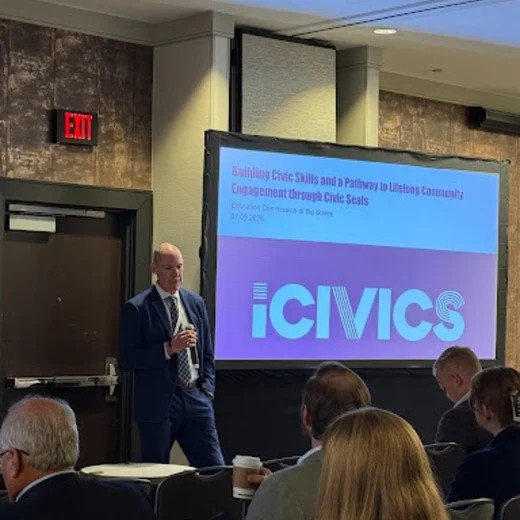
Education Commission of the States
On July 9, iCivics leaders Shawn Healy, Mya Baker, and Chloe Jordan led a session at the Education Commission of the States National Forum in Washington, D.C. Their session, Building Civic Skills and a Pathway to Lifelong Community Engagement Through Civic Seals, explored the national growth of civic seals and how iCivics and CivxNow support their implementation.
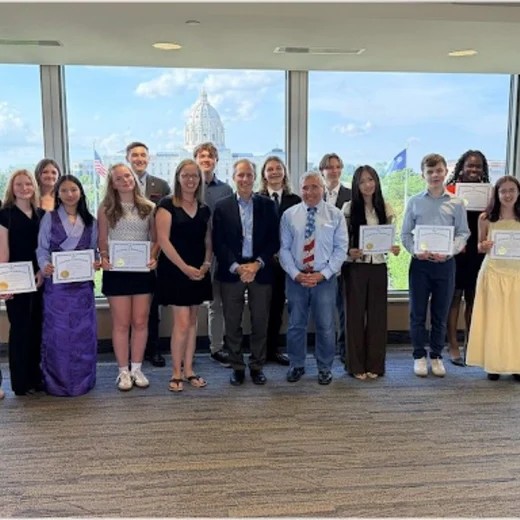
Minnesota's First Civic Seals Recipients
This month, Minnesota celebrated its first-ever graduates to earn the Civic Seal on their diplomas, including students who successfully advocated for local policy and expanded the program in their districts. Supported by iCivics, the YMCA Center For Youth Voice, and the Minnesota Secretary of State, this initiative highlights the powerful impact of young people when given the opportunity to participate in our democracy.
Coalition Partner Spotlight: National Association of State Boards of Education
In the News
With summer still underway, there remains some heat around civics in the media:
- Education Week wrote about a new RAND study that shows that civics classes may be on the rise, but only a third of districts offer experiential civic learning, with only 13% requiring it.
- Former Virginia Secretary of Education Aimee Rogstad Guidera wrote a piece in Education Next about why the 250th is a time for a civic education renaissance, and how it is happening in Virginia.
- The New York Times published an open letter from 16-year-old Chan-Yul Kim, a high schooler in Austin, Texas, about why schools should prioritize civic education.
- Bill of Rights Institute President and CEO David Bobb wrote in Education Week that at the 250th, civics classes need more civil disagreement.
- Joshua Dunn and William Lyons, who direct the Institute of American Civics at the University of Tennessee, wrote in RealClearEducation about how the Institute’s Civics Academies work.
Coalition Members
We remain deeply appreciative of member efforts and all that we accomplish together. Our goal is to aggregate and activate large networks of support to expand and re-imagine civic education as a force for civic strength. To our members, thank you for your partnership.
If your organization is interested in joining CivxNow or in learning more, please contact us at CivxNow@icivics.org.
Related Posts
August 2026: Strengthening Civics: Seals, New Assessment & Policy News
NEWSLETTERS AUGUST 2026 News From the Front Lines of Civic Education Teaching by Doing: Why Students Are Choosing Civic Seals
August 2026
An Assessment Playbook for Civics Civics has been lamentably lost in the shuffle in this now-decades-long, high-stakes testing era. However,