A Renewed Commitment to American Civics: State-Led Initiatives Gain Momentum

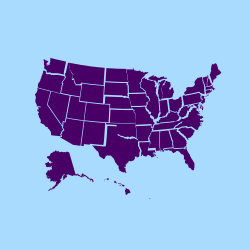
A notable trend is emerging across the U.S. as state legislatures increased their focus on strengthening civic education this Spring legislative session. Since 2021, 26 states have adopted 42 policies aligned with the CivxNow State Policy Menu, our framework for strengthening civic learning. The momentum continues this year, with 45 states considering 198 bills related to K–12 civic education. Of these, 145 (73%) are aligned with the policy menu, signaling a bipartisan consensus that civic education is a priority in states. 

Recent Legislative Successes in Civic Education

Several states recently enacted significant legislation to reinforce the importance of civics:

  • Utah: Governor Cox signed H.B. 381 into law, which he described as one of the most important bills of the session. The legislation amends high school graduation requirements to include a year-long course on American constitutional government and citizenship.
  • Missouri: Demonstrating a consistent commitment, the Missouri legislature renewed its $500,000 appropriation for professional development in civics and patriotism for the third consecutive year.
  • Louisiana: An initiative championed by State Superintendent of Education Cade Brumley will create a special “Freedom Seal” for graduating students’ diplomas. The seal is designed to incentivize and recognize achievement in learning U.S. history and understanding the political process.
  • Alabama: A new appropriation of $1,500,000 will develop an online course in U.S. history, government, and/or civics. This resource will be available to all pre-K–12 teachers to support instruction aligned with the Alabama Course of Study.

Pending Legislation and Budgetary Considerations

As of the writing of this newsletter, important work continues through the legislative and budgetary process in Massachusetts, Michigan, and Ohio. 

Upcoming Policy and Educational Events

Our focus now turns to building momentum and support for the next session with several key fall events in Colorado and Ohio. Additionally, the Missouri Civic Learning Coalition and the Missouri Historical Society will host a civic education event focused on pluralism on September 30 at the Missouri History Museum in St. Louis. In Kansas, CivxNow will co-sponsor a youth-centered civic summit at Washburn University on November 4 and 5, led by the Kansas Volunteer Commission and friends at the Dole Institute.

TEST FORM

Strong Showing for CivxNow During Inaugural Hill Day

Last Thursday, the CivxNow Coalition hosted its first-ever Hill Day in the nation’s Capital. Fifty civic learning advocates visited 40 congressional offices to make the case for sustainable, and ultimately, a generational investment in K–12 students’ civic development. A bipartisan cohort of Congresspeople and Senators graciously received our hopeful message during these perilous, polarized times.

Our group of students, educators, veterans, and community partners visited members of key congressional appropriations committees and respective state delegations. At stake is the current $23M annual investment in American History and Civics National Activities and Academies for the coming fiscal year (2026) that begins in October.

CivxNow members spoke to the impact of these investments, touching an estimated 4,000 teachers and 400,000 students. They expressed how a modest increase in funding would further scale civic learning opportunities for students and professional development for their teachers.

On the horizon next July is the 250th anniversary of this great nation, a clarion call for policymakers to transcend fireworks and tall ships in commemoration and ensure that our youngest Americans graduate with an understanding of the rights and responsibilities of American democracy.

Kindergartners entering school this fall represent the Class of 2038, our next civic milestone when the U.S. Constitution turns 250. Can we guarantee that they will graduate with a deep understanding of the Declaration of Independence, a document longtime civics supporter Jack Miller likens to our national mission statement? Similarly, the Constitution is our longstanding strategic plan for governance. Imperfect, yet alterable by design, it is imperative that our youngest citizens understand the separate and shared powers across our three branches of government, the amendment process, and the Bill of Rights addendum as a condition of state ratification.

Depressing statistics of poor civic knowledge represent a self-fulfilling prophecy given civics’ marginalization in schools and paltry public investments, including less than 50 cents per student at the federal level. We can and must do better for our national posterity.

The CivxNow Coalition put its best foot forward last week in the Capital, doing civics for civics. After all, our students, teachers, and practitioners are the on-the-ground experts of effective civic learning practices and how our schools, districts, and communities stand to benefit from additional federal investment. We are deeply grateful for our partners who came from near and far to take part in this inaugural effort, sharing their authentic insights of the life-changing impact of civics in districts and states.

For most of us, entering the ornate congressional office buildings with staffers and members dressed in fancy suits is very intimidating. Add the fact that our field is resource-starved, and we present little more than the power of our stories and the vast constituencies we represent. But these offices belong to us as citizens. A plaque I encountered upon entering the office of Congressman Raja Krishnamoorthi affirmed this principle: “This office belongs to the people of the 8th Congressional District of Illinois.”

We delivered a civics lesson of our own during the first ever CivxNow Hill Day: The Declaration of Independence is our birthright, and the Constitution a compact of democratic governance with “We the People.” Congress must ensure that the rising generation proudly takes this baton at America250 and works within our institutional frameworks to “build a more perfect union.”