April 2026: From the Classroom to the Statehouse: Celebrating Educator Allies

News From the Front Lines of Civic Education

Teacher Leaders at the Center of Civics Policy Push

Teachers are our most authentic, effective advocates for stronger K–12 civic learning, whether leading in the classroom or as policymakers. With 40 states currently considering 232 civics policies, we are highlighting the “heroic act” of teaching by celebrating the current and former educators championing this legislation as elected officials.

From Indiana to Hawaii, these leaders are leveraging their expertise to establish standalone courses and vital funding, while our 620-member TACL coalition continues to move the needle on federal policy.

Research Roundup

New research from scholar Ari Kim, titled Civic Capital in Uneven and Uncertain Times, highlights that open classroom climates serve as a “great equalizer” for students’ civic development.

While students enter school with varying levels of civic capital, this study finds that intentional classroom interventions can bridge social inequalities to boost civic knowledge and participation.

These findings suggest that prioritizing information literacy and strategies for engaging with controversial issues is essential for building a student’s sense of belonging and commitment to the common good.

pie chart icon

AI Corner

The Stanford Institute for Human-Centered Artificial Intelligence (HAI) 2026 AI Index Report highlights a critical gap: 80% of students use generative AI, yet only 6% of teachers have clear district guidance. This disparity underscores that AI literacy is now a civic necessity, essential for helping future voters critically evaluate information in a digital democracy. To prepare the next generation, we must move toward intentional K–12 instruction and robust policies that treat AI as a universal civic skill.

On the Road
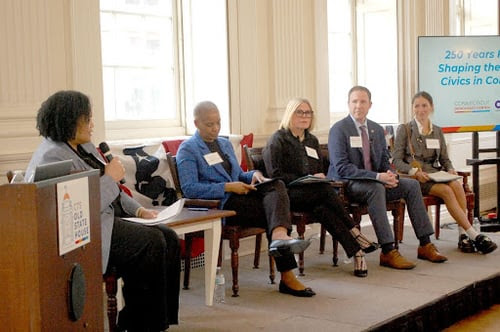
panel of speakers at Connecticut Civic Learning Coalition event

250 Years Forward: Shaping the Future of Civics in Connecticut
The Connecticut Democracy Center convened leaders in Hartford to celebrate the launch of the Connecticut Civic Learning Coalition and the establishment of a state civic seal. The event featured a national policy keynote and a deep dive into local legislation, bringing together students and educators to generate bold ideas for the Constitution State’s future.
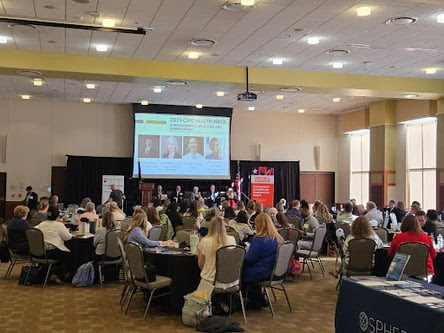
attendees at Indiana Civics Summit

Indiana Civics Summit

The Indiana Bar Foundation and iCivics hosted the fourth annual Indiana Civics Summit, highlighting the state’s national leadership in K–12 civic education policies. The convening brought together over 120 attendees, including nearly 60 educators who engaged in specialized sessions on civics pedagogy to further strengthen learning at the crossroads of America.

Coalition Partner Spotlight: Democratic Knowledge Project

The Democratic Knowledge Project (DKP) aims to build a world where a supermajority of young people believe democracy is essential and feel confident they have the knowledge, capacities, and skills needed to participate in civic life. DKP pursues this goal through civic education research and through offering curriculum and professional learning aligned with the Roadmap to Educating for American Democracy.
In the News

Spring has sprung some interesting news in the civics world:

  • The New York Times took a deep dive into the UNC School of Civic Life and Leadership, one of the many college-based schools on civic thought that have cropped up across the country.
  • Rick Hess has a one-on-one with Richard Kahlenberg about how to teach what it means to be an American in his Education Week column.
  • Center for Civic Education’s Donna Phillips discussed the importance of civic education and the Center’s “We the People” competition national finals on C-SPAN.
  • Sam Westerdale, a civics teacher in Aurora, CO, spoke to Chalkbeat about how she’s approaching teaching civics during the nation’s semiquincentennial.

New Member

CivxNow continues to grow, now officially standing at more than 410 member organizations! The latest addition:

We remain deeply appreciative of member efforts and all that we accomplish together. Our goal is to aggregate and activate large networks of support to expand and re-imagine civic education as a force for civic strength. To our members, thank you for your partnership.

If your organization is interested in joining CivxNow or in learning more, please contact us at CivxNow@icivics.org.

Related Posts

April 2026

 Open Classrooms Key to Students’ Civic Development

Penn State Education Policy Studies scholar Ari Kim finds that open classroom climates can help students surmount social inequalities as they develop civic knowledge, attitudes, and behaviors in her January 2026 research article Civic Capital in Uneven and Uncertain Times. The author defines open climates as classrooms where political discussions are encouraged, pluralistic perspectives presented, and respectful debates about current public issues are commonplace.

Kim’s study draws from an international sample of 8th grade students across 15 countries. The author finds that while students bring varying levels of civic capital into schools depending upon their family and socioeconomic backgrounds, classroom interventions can serve as a great equalizer, yielding positive growth in civic knowledge, efficacy, and participation. Moreover, while civic knowledge and efficacy declined over the course of the study, civic participation rose, a product of lowered barriers to entry via technology and changing sociopolitical contexts.

This study has significant implications for practice and policy:

  • Given the importance of open classrooms, educators’ professional learning should emphasize strategies for structured engagement with controversial issues and centering student voice.
  • As civic engagement assumes increasingly digital forms, information literacy is a core component of students’ civic development.
  • Post-pandemic, we must attend to students’ civic knowledge and build a sense of belonging and commitment to the common good. Pedagogical strategies like those detailed above and throughout the Roadmap to Educating for American Democracy should become the new norm.

AI Corner

The 2026 AI Index Report from the Stanford Institute for Human-Centered Artificial Intelligence (HAI) highlights a critical gap in civic readiness. While four out of five U.S. students now use generative AI for their schoolwork, only half of middle and high schools have formal AI policies in place. This disparity underscores the urgent need for robust AI literacy in K–12 education. To prepare the next generation for a landscape in which AI is no longer a niche technology, but a fundamental part of the workforce and public discourse, we must move beyond incidental use and toward intentional instruction. By integrating AI literacy into our schools, we empower students to not only navigate these tools effectively but also to understand the ethical implications and societal impacts of the technology shaping their future.

Key Takeaways from the education section of the report:

  • The Usage Gap: 80% of students are using AI for research and brainstorming, yet only 6% of teachers report having clear guidance or policies from their districts.
  • Global Momentum: National mandates for AI education are rising globally, with countries like China and the United Arab Emirates implementing formal curricula for the 2025–26 school year to ensure national competitiveness.
  • Literacy vs. Engineering: There is a global trend of “AI literacy” (understanding and using AI) growing faster than technical “AI engineering” skills, signaling that AI is becoming a universal civic skill rather than just a technical one.

Ultimately, fostering a deep understanding of AI is not just a technical requirement, but a civic necessity, ensuring that students, educators, future voters, and community members can critically evaluate information and participate meaningfully in an increasingly digital democracy.

Teacher-Leaders at the Center of Civics Policy Push

Teachers are our most authentic, effective advocates for stronger K–12 civic learning across the country. Whether in the classroom or in second careers as policymakers or in other places across the civics landscape, we celebrate educators who prioritize students’ civic development on the eve of Teacher Appreciation Month in May.

From 2021–2025, 33 states adopted at least 50 pro-civics policies, and this forward momentum continues this spring with 40 states considering 232 policies concerning K–12 civic education. We’ll provide a complete recap of the spring session in a subsequent newsletter, but this month we want to highlight the current and former teachers now championing civic learning as elected officials across states.

  •  Indiana State Representative Tony Cook (R)—former social studies teacher, football coach, and principal—sponsored 2021 legislation to create a state civic education commission and require a standalone middle school civics course.
  • Minnesota State Senator Steve Cwodzinski (D)—a high school civics and history teacher for three decades—championed 2023 legislation that established  a standalone high school civics course requirement in Minnesota and is the lead author of legislation to establish a civic seals program.
  • Utah State Representative Douglas Welton (R)—a current history and world languages teacher and debate coach—advocated for a law to extend the state’s one-semester high school civics course to a full year starting with the 2026–2027 school year, allowing for a greater focus on state and local government, including study of the state constitution.
  • Ohio Governor Mike DeWine (R) trained to be a social studies teacher and has been an ally of the field during his two terms as chief executive. In 2019, Gov. DeWine signed legislation that established a civic seals program in the state and, last year, he successfully requested appropriations for an elementary-level literacy curriculum that infuses social studies content.
  • Hawaii State Representative Amy Perruso (D)—a social studies educator for nearly 20 years—serves as vice chair of the Commission to Promote and Advance Civic Education (PACE), and is the current sponsor of legislation to establish a civics trust fund, drawing upon public and private funding, to support civics programming in middle schools.
  • Connecticut State Representative Kevin Brown (D) is still in the classroom teaching civics (18+ years) and on the field coaching youth sports. He carried legislation the past two sessions to establish a civic seals program. This spring, it passed as part of a broader education package, and was signed into law by Governor Ned Lamont last month.

Teachers need not pursue elected office to “do civics for civics.” Over the past couple of years, the CivxNow coalition’s Teachers Advancing Civic Learning (TACL) has empowered teachers to advocate for stronger state and federal civic education policies. Now more than 620 members strong and representing 49 states, TACL members participate in quarterly trainings, receive monthly activation opportunities and policy updates, and engage in targeted state and federal policy campaigns.

Teachers also joined an educator-focused Hill Day last year held in partnership with the National Council of the Social Studies (NCSS) at the start of their annual conference. More than 40 participants representing 24 states visited more than 50 congressional offices, meeting with House and Senate members and staff from both sides of the aisle. We are currently planning a second Hill Day, bringing together educators, partners, and coalition members to advocate for civics and history education, on July 15, 2026, to coincide with NCSS’ Summer Leadership Institute. 

Teaching civics during this time of deep political polarization is a heroic act, and we are grateful for our educator allies. We salute all educators during Teacher Appreciation Month and throughout the year, and we invite your participation in our coming collective impact activities on Capitol Hill and across states.