August 2026: Strengthening Civics: Seals, New Assessment & Policy News

News From the Front Lines of Civic Education

Teaching by Doing: Why Students Are Choosing Civic Seals

States are answering the call for stronger civics, with 20 states now having civic seals in place and at least 7 others pursuing legislation or pilots.

Unlike imposed standards, a civic seal stands apart because a student chooses it, credentialing what a student actively did rather than what a state teaches. The critical next step is ensuring these seals hold real-world currency by connecting them to higher education, scholarships, and employers, giving full value to students who already did the hard part.

Research Roundup: An Assessment Playbook for Civics

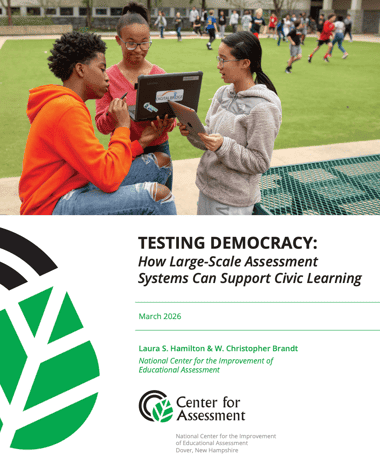
In their report, Testing Democracy: How Large-Scale Assessment Systems Can Support Civic Learning, researchers Laura S. Hamilton and W. Christopher Brandt contend that states, districts, and schools can creatively assess civic learning to ensure universal access, quality, and students’ civic preparedness.

Exploring approaches from incentive-based civic seals to school climate surveys, the authors recommend that education leaders engage stakeholders, build a clear theory of action, and integrate civics into large-scale reading assessments. Thanks to Hamilton and Brandt, the field has a new playbook to strengthen civic assessment and ensure students are prepared for lifelong engagement in our constitutional democracy.
On the Road
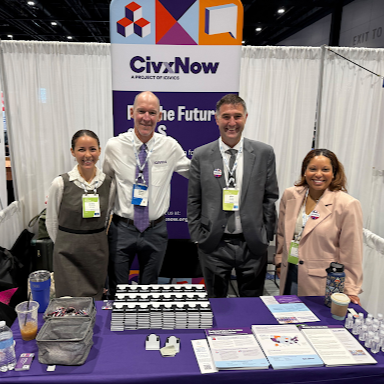
iCivics policy staff tabling at NCSL conference

National Conference of State Legislatures

iCivics’ state policy team connected with lawmakers from across the country at the National Conference of State Legislatures (NCSL) Legislative Summit in Chicago, where iCivics Chief Policy and Advocacy Officer Shawn Healy spoke on an America 250 panel dedicated to strengthening civic education.
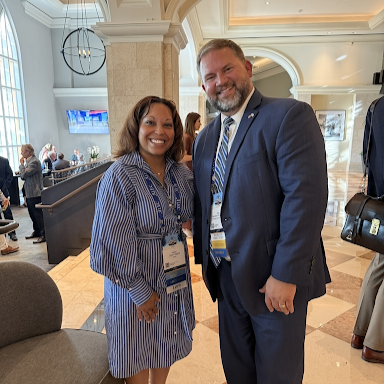
iCivics Southeast State Policy Lead Chloe Jordan with Arkansas State Senator Jim Dotson at American Legislative Exchange Council

American Legislative Exchange Council

At the American Legislative Exchange Council (ALEC) Annual Meeting in Orlando, iCivics Southeast State Policy Lead Chloe Jordan met with lawmakers from across the country to discuss civic education model policy, including plans with Arkansas State Senator Jim Dotson to advance a civic seal bill in 2027.

Coalition Partner Spotlight: Generation Citizen
Through community-based civic education, legislative advocacy, and youth leadership development, Generation Citizen teaches young people how to become informed, engaged citizens. Partnering with school districts, educators, and community members, they transform how civics is taught so students can make a difference on local issues they care about. Generation Citizen also leads the way in forging partnerships to advance civic seal legislation in states like Washington, Maryland, Rhode Island, and New York.

In the News

Some last-minute civics reading as you get back to school:

  • James Traub looks into Texas’ move toward a classical model of teaching social studies and history in this op-ed in The New York Times.  
  • Sheria McRae, CEO of Foundation Academies, makes the case for place-based history and helping students see themselves in history in this piece in District Administration.
  • This summer, a group of 98 high school students took the civic act of creating a framework for how AI should be used in schools, according to this story in Education Week.
  • Cal Matters says that allowing kids to vote before they are 18 won’t matter if they aren’t taught how to vote. 

Coalition Members

CivxNow continues to grow, now standing at more than 400 member organizations! The latest additions are:

We remain deeply appreciative of member efforts and all that we accomplish together. Our goal is to aggregate and activate large networks of support to expand and re-imagine civic education as a force for civic strength. To our members, thank you for your partnership.

If your organization is interested in joining CivxNow or in learning more, please contact us at CivxNow@icivics.org.

Related Posts

August 2026

An Assessment Playbook for Civics Civics has been lamentably lost in the shuffle in this now-decades-long, high-stakes testing era. However,

Read More

August 2026

An Assessment Playbook for Civics

Civics has been lamentably lost in the shuffle in this now-decades-long, high-stakes testing era. However, researchers Laura S. Hamilton and W. Christopher Brandt contend that states, districts, and schools can creatively assess civic learning to ensure universal access, high quality, and students’ civic preparedness in their March 2026 report, Testing Democracy: How Large-Scale Assessment Systems Can Support Civic Learning (Center for Assessment).

The researchers cite CivxNow state policy scan data showing 29 states with some form of civic assessments, yet most employ some version of the U.S. Naturalization Test, an instrument not designed to assess standards proficiency nor course completion. By contrast, Florida’s high-stakes end-of-course assessments in middle and high school civics and American government, respectively, are the exception.

Civic seals, profiled in this month’s feature article are an incentive-based approach by which a growing body of states are assessing students’ civic preparedness. Seals hold significant promise as states and districts seek to measure desired student competencies like deliberation across differences  and community engagement.

States, districts, and schools also draw upon school climate surveys to assess students’ civic learning opportunities, along with student participation in advanced courses. Taken together, there is no unified approach by which civics is assessed nationally, although recent news of state-level data from the next NAEP Civics Assessment in 2028 is a major step, yet insufficient by itself.

The researchers recommend that:

  • Education leaders engage key stakeholders in conversation about local civic learning priorities;
  • A theory of action flows from these conversations, connecting civic learning opportunities with intended student outcomes;
  • Civics is integrated into large-scale reading and English/Language Arts (ELA) assessments; and
  • This holistic approach to assessment informs ongoing civics-focused school improvement processes.

Thanks to the contributions of Hamilton and Brandt, the civic learning field has a new playbook to strengthen and broaden civic assessment. In turn, this will help to ensure universal access to high-quality civic learning and students’ preparation for informed, effective, and lifelong engagement in our constitutional democracy.

Teaching by Doing: Why Students Are Choosing Civic Seals

As noted when this year’s state legislative sessions were wrapping up, states have been answering the call for stronger civics in this 250th year, many through civic seals. 

This was particularly true in Montana, where the Seal of Civics Literacy came as a result of the state’s 250th commission working together with the superintendent and board of public education. Just 15 weeks after the new Seal was announced, students were submitting applications.

With 20 states now having civic seals in place and at least 7 others with pilot programs and/or contemplating legislation next spring, the bipartisan momentum is real and building. CivxNow is committed to supporting every state in making this vision a reality, lifting up civic seals as a priority policy and convening a community of practice for state leaders as they move to the harder work of implementation.

What makes civic seals unique?

  • A student chooses it. Standards, mandates, and required courses all work the same way: they are imposed. A civic seal stands apart because a student chooses it, it measures action, and it teaches by doing.
  • It credentials what a student did, not what a state teaches. Too much civic education treats students as passive observers. A seal inverts that. Rather than simply absorbing curriculum, the student is putting civic learning into practice, demonstrating the very competencies deemed essential in states’ portrait-of-a-graduate frameworks.

Next Steps

As with many policies, adoption is only the first step—implementation is everything. 

Montana built a civic seal in 15 weeks with no legislation, no appropriation, and no controversy. That speed was not an accident. It was the product of a design that sidesteps fights that have too often stalled civic education for a decade. What Montana has not done, and what no state has done, is ensure the seal holds value for students beyond the diploma enhancement, connecting it to institutes of higher education, scholarship funds, and/or employers.

A couple of efforts are underway to make this value proposition more explicit, including Illinois’ HB 4330 that would require every public college and university to accept the Seal for admissions and credit. Similarly, a resolution was introduced before the New York City Council asking the City University of New York (CUNY) to grant credit for the state’s Seal of Civic Readiness. 

That is the missing piece. It is also the smallest piece. One university, one statute, one sentence and the seal stops being a notation and becomes currency. The students already did the hard part.