January 2026: Fresh Perspectives for a New Year of Civic Learning

News From the Front Lines of Civic Education

A Heartfelt Farewell from Coalition Engagement Director Ace Parsi

After five years of leading the CivxNow coalition, Ace Parsi is transitioning to a new chapter in public service. In this moving reflection, Ace shares what he has learned from working with the coalition and why he believes civic learning is a sacred trust.

Research Roundup: Young Americans' View of News Media and Journalism

The News Literacy Project published Biased, Boring, and Bad, a national survey exploring how young Americans view news media and journalism.

The report documents that a vast majority of teens hold negative views of contemporary media, often struggling to find information they perceive as honest or balanced. Key findings stress that fostering news literacy is essential to rebuilding trust, and that teaching young people to distinguish between standards-based journalism and other forms of information is vital.

pie chart icon

EAD Survey Responses Requested

The Educating for American Democracy (EAD) Community Learning Partners (CLP) Network Task Force is seeking your feedback to better understand the impact of the EAD Roadmap on the civics field. Complete this 10-minute survey for a chance to be invited to the November 2026 summit at Monticello, with travel stipends available.

Are You Ready for Civic Learning Week?

Civic Learning Week (March 9–13) is fast approaching and it’s time to start planning your celebration of civic education.

Use the toolkit to organize your activities, add your events to the national map, and share your participation using our social media resources.

On the Road

New York Civics Day

On January 9, iCivics joined students and leaders at Generation Citizen’s New York Civics Day to celebrate young changemakers as they presented community-based policy proposals and dialogue-driven solutions.

2025 Indiana Civic Health Index

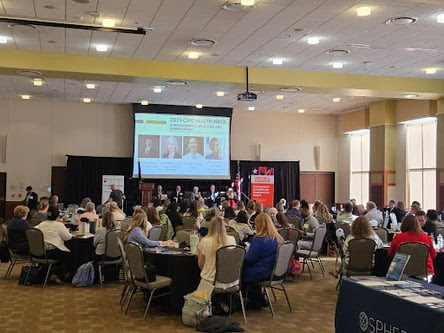
On January 21, the Indiana Bar Foundation released the 2025 Indiana Civic Health Index, highlighting that Indiana is the only state to meet all eight policy recommendations from the CivxNow State Policy Scan.

In the News

A new year and a new round of interest in civics:

  • EdSurge looks ahead to how civics will take center stage during America 250
  • 2024 National Civics Bee winner Emily Brubaker makes the case that civics is for kids, not just adults, in this Newsweek op-ed
  • Former Anaheim Schools superintendent Michael Matsuda says democracy is not a spectator sport and needs to be at the center of public education in this EdSource piece
  • The Wall Street Journal looks at a new bill that would require New York schools to teach about what happened at the U.S. Capitol on January 6, 2021
  • SuperTalk Mississippi Media covers Senator Bryce Wiggins’ efforts to make civics a mandatory high school subject in the state.

New Members

CivxNow continues to grow, now officially standing at more than 400 member organizations! The latest additions are:

We remain deeply appreciative of member efforts and all that we accomplish together. Our goal is to aggregate and activate large networks of support to expand and re-imagine civic education as a force for civic strength. To our members, thank you for your partnership.

If your organization is interested in joining CivxNow or in learning more, please
contact us at CivxNow@icivics.org.

Related Posts

January 2026

Young Americans have decidedly negative views of news media and journalism, according to a national survey published in November 2025 by the News Literacy Project (NLP). Biased, Boring, and Bad follows up on NLP’s 2024 Survey of Teen Information Attitudes, Habits, and Skills.

Among the key findings:

  • The vast majority of teens (84%; ages 13-18) surveyed expressed negative views of contemporary media.
  • Teens believed that journalists engage in deceptive practices (81%) and don’t do anything well (66%). This includes giving advertisers special treatment; making up details, such as quotations; paying or doing favors for sources; and taking photos or videos out of context.
  • Young people’s top recommendations to journalists are to be honest, factual, minimize bias, and improve balance.

As was evident in last year’s survey, teens with higher trust in news media had more positive views of professional journalists and news organizations. For example, high-trust teens were more than twice as likely to say that journalists correct errors when they happen, and are half as likely to believe that news organizations give advertisers special treatment.

NLP concludes the survey with three recommendations:

  1. Encourage young people to distinguish between standards-based journalism and other forms of information;
  2. Teach students verification skills and how standards-based newsrooms operate; and
  3. Foster accurate perceptions of journalism by challenging sweeping generalizations about modern media and exposing students to high-quality journalism.

Dec 2025: Our 2025 Impact: Celebrating Wins and Planning the Road Ahead

News From the Front Lines of Civic Education

Crucial March Toward Stronger Civic Education Continued in 2025

This year, we continued our crucial march to strengthen K–12 civic learning from coast to coast.

Through the strength of our coalition, which now stands at over 400 members, we celebrated educators, elevated teacher voices in Washington, D.C., and ensured civic learning is central to the planning for the nation’s 250th.

Plan Your Civic Learning Week Involvement

Use the Organization/Influencer Toolkit to access resources to help you plan and communicate your participation in Civic Learning Week 2026.

The toolkit includes planning resources, tips for engaging youth voice, sample social media posts, graphic assets, sample emails and press materials, and more.

Research Roundup: Hoover Institution Completes Civic Learning Landscape Analysis

Last month, the Hoover Institution published a comprehensive landscape analysis of The American Civic Education System.
 
The report documents that the marginalization of civic learning is generational and that efforts to scale solutions often lack coherence. Key observations stress that political polarization must be mitigated, and that educators require more in-person professional development.
pie chart icon

On the Road

Hill Day picture of participants behind podium
Photo of Hill Day participants in Congressional office

State Policy Lead Andrea Benites and Policy Associate Sydney Moore attended the 105th National Council for the Social Studies (NCSS) Annual Conference in Washington, D.C.

The conference featured a powerful Hill Day where the team supported teachers in advocating for increased investment in civics education on Capitol Hill. Energizing keynote sessions left a lasting impression on the CivxNow team.

In the News

Winter Break reading:

  • NPR takes a look at a long-running moot court contest in NYC that teaches high school students how government works.
  • iCivics CEO Louise Dubé and Chief Education Officer Emma Humphries penned a piece for AllSides about why we must continue to teach hard topics.
  • James Traub asks if we could pass the updated naturalization civics test in this op-ed in The New York Times.
  • Wisconsin Watch explains how a retiree’s passion for local office sparked a statewide high school civics contest.

New Members

CivxNow continues to grow, now officially standing at more than 400 member organizations! The latest additions are: We remain deeply appreciative of member efforts and all that we accomplish together. Our goal is to aggregate and activate large networks of support to expand and re-imagine civic education as a force for civic strength. To our members, thank you for your partnership. If your organization is interested in joining CivxNow or in learning more, please contact us at CivxNow@icivics.org.

Related Posts

December 2025

Last month, our partners at the Center for Revitalizing American Institutions (RAI) at the Hoover Institution published a landscape analysis of The American Civic Education System. Based on an extensive literature review, individual interviews and focus groups, and a survey of educators and students, RAI documented three broad trends all too familiar to the civic learning field:

  1. The marginalization of civic learning is generational in nature;
  2. Civic learning is vital to the strength and sustenance of our constitutional democracy and transcends ideological divides; and
  3. While the civic learning field has rallied to meet the challenge of the moment, our efforts often lack coherence and we struggle to scale them across our P-20 system.

The report proceeds to make more specific observations, several of which bear repeating:

  • While tensions between liberty and democracy are inherent to our system, toxic political polarization is not and must be mitigated;
  • Civic learning must be taught as a stand-alone subject across grade bands, but also integrated across subject areas to ensure greater emphasis;
  • There is no shortage of civics curricula and resources, but there are a dearth of materials focused on international relations, military, and national security;
  • Civic learning is excessively siloed within K–12, higher education, and civil society; and
  • Educators want greater access to in person professional development opportunities where they engage with subject matter experts and learn from one another in community.

The authors conclude by recognizing the role for bridge-building leaders and institutions given the aforementioned challenges, one that the CivxNow coalition aspires to play with its 400-plus, pluralistic members in partnership with RAI. This report is an important contribution to our collective work to strengthen our P-20 civic education system.

Nov 2025: Civic Education This Season: Bridge Divides and A250 Prep

News From the Front Lines of Civic Education

Civic Education This Thanksgiving

This season, we look beyond the tradition of turkey hats to focus on the civic learning field’s deeper purpose: building young people’s capacity to navigate complexity and bridge divides.

We invite you to engage in three essential actions that elevate educators and strengthen classroom conversations. 

Civic Learning Week National Forum

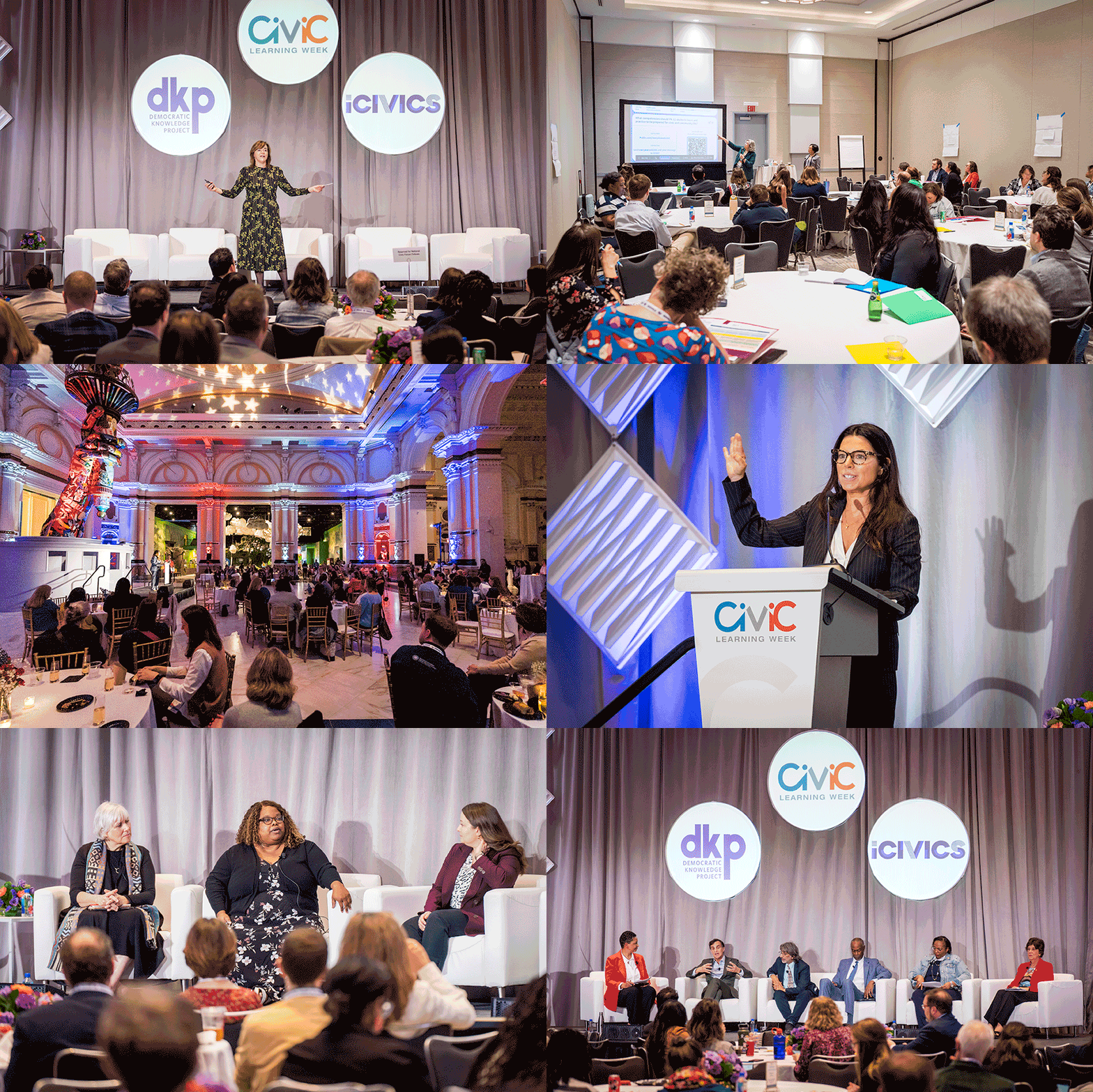
Registration is now open for the 2026 Civic Learning Week National Forum, Liberty and Learning: Civic Education at 250.

Hosted by iCivics and the Democratic Knowledge Project, the forum will be held March 9–10, 2026 at the Loews Philadelphia Hotel. We will explore key topics related to the importance of liberty and learning, what that looks like in practice, and the leadership needed to make high-quality civic education a nationwide priority.

Liberty and Learning: Civic Education at 250 Civic Learning Week National Forum logo with stylized book people and star

Book Review: Reclaiming Patriotism in an Age of Extremes

As the United States prepares for the 250th anniversary of its Declaration of Independence (A250) in July, Steven Smith’s Reclaiming Patriotism in an Age of Extremes explores the true meaning of patriotism.

Smith defines patriotism as a form of loyalty and a “learned disposition” which is the very component of an educated mind, making the seeking of knowledge and understanding a powerful act of patriotism for A250. 

On the Road

Colorado Civic Readiness for All

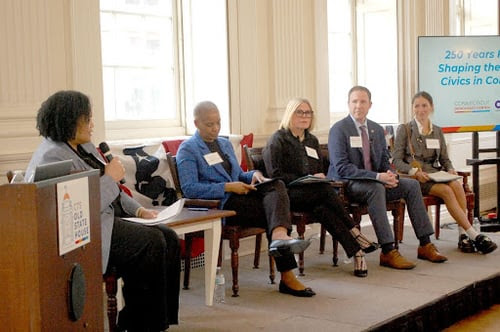
Leaders from education, policy, and community sectors gathered in Denver on Nov. 4 to leverage the upcoming 150th anniversary of Colorado’s statehood (CO150) and A250 commemorations through partnerships to ignite civic engagement.

Speakers on stage

The Constitutional Democracy Project

The Constitutional Democracy Project held its annual conference for civics teachers on Oct. 31, featuring a surprise appearance by Illinois Senator Dick Durbin, a longtime supporter of civics and history education.

In the News

Civics in the news as we head into Thanksgiving:

  • NPR spoke to a number of CivxNow partners in this piece about the $150 million in grants that just went to civic education.
  • Rick Hess discusses “real-world civic education” in this piece in Education Next.
  • Jeffrey Edward Green writes that civic education should challenge students in this Boston Globe piece.
  • U.S. Supreme Court Justice Neil Gorsuch told a local Fox network that lack of civic education is our country’s biggest problem—and he’s following a trend of Justices who have written children’s books. 

New Members

CivxNow continues to grow, now officially standing at more than 400 member organizations! The latest additions are: We remain deeply appreciative of member efforts and all that we accomplish together. Our goal is to aggregate and activate large networks of support to expand and re-imagine civic education as a force for civic strength. To our members, thank you for your partnership. If your organization is interested in joining CivxNow or in learning more, please contact us at CivxNow@icivics.org.

Related Posts

November 2025

Patriotism is in the air as the United States prepares for the 250th anniversary of its Declaration of Independence in July. Yet the true meaning of patriotism and how to cultivate it among citizens is a matter of fierce debate. Steven Smith attempts to bridge current ideological chasms and offer a unifying brand of American patriotism in his 2021 book Reclaiming Patriotism in an Age of Extremes (Yale University Press).

The United States, from its inception, was a “creedal nation,” meaning that being an American meant adherence to a set of core beliefs: equality, individual rights, liberty, and limited government, among them. This is juxtaposed with an ascendant nationalism on the political right, and a cosmopolitan, or “citizens of the world” concept, prevalent on the left. Smith attempts to reclaim patriotism from these poles in this fraught political moment.

The author defines patriotism as “a form of loyalty to…one’s constitution or political regime.” American patriotism is aspirational: “To be an American is to be continually engaged in asking what it means to be an American.”

Moreover, patriotism, Smith writes, is a “learned disposition” as opposed to indoctrination. Instead, it is a “component of an educated mind.” In this sense, one of the strongest acts of patriotism we can all engage in for A250 is simply the learning and the seeking of knowledge and understanding of history and civics. 

Smith compares the Declaration of Independence and Constitution with core religious texts: the former emphasizes individual rights, while the latter establishes self-government through federalism. These seminal documents breed a form of “civic faith,” what Lincoln called the “political religion of the nation.”

We are therefore a textual people, participants in ongoing debates over the true meaning of our creed. These debates are core to American patriotism and its enlightened form that Smith elevates as the root of what makes America exceptional.

In this year of the semiquincentennial, may the teaching of American virtues, namely civility, rule of law, mutual respect, responsibility, and leadership, among others, flourish in our K–12 classrooms and cultural institutions as we pass along this precious birthright to our posterity.

Oct 2025: Civic Consequences of AI and Experiential Learning Research

News From the Front Lines of Civic Education

New Report Highlights Civic Consequences of AI

In partnership with the EDSAFE AI Alliance, CivxNow is excited to release an urgent new report, States of the Union: Rebuilding American Civics for a Digital Republic

While many reports focus on the economic effects of AI, this document emphasizes its civic consequences, specifically how it will influence citizens’ relationships with one another and with core American values like life, liberty, and the pursuit of happiness.

Civic Holidays Spotlight

We are grateful to CivxNow members New Voters, Blue Star Families, and the Lincoln Presidential Foundation for leading celebrations around three upcoming civic holidays: Election Day; Veterans Day; and Thanksgiving.
star icon

Research Roundup: Experiential Civic Learning for American Democracy

Experiential Learning research report cover

This month, the Task Force on the Value of Experiential Civic Learning—composed of several CivxNow partners—produced Experiential Civic Learning for American Democracy: A Portrait of the Field.

The report found that experiential learning and a focus on core civic knowledge are critical pillars of a comprehensive civic education. It defines experiential civic learning and identifies its goals, teaching practices, and barriers to participation and implementation.

On the Road

group of people standing in front of stone arch

Civic Readiness for All

Civic Readiness for All took place on Oct. 15 at the Ohio Statehouse. The event featured a panel moderated by Shawn Healy and included Mya Baker, alongside other key stakeholders, all working to strengthen K–12 civic education in the Buckeye State.

group of people standing in front of projection screen with text reading #DemocracySchools

Democracy Schools

Illinois Democracy Schools held a daylong civic learning convening on Sept. 23. The event, moderated by Shawn Healy, featured an opening panel of state superintendents from Hawaii, Illinois, and Wisconsin, alongside delegations from other states who are working to launch or scale civics recognition programs for schools.

In the News

It was a big month for civics:

New Members

CivxNow continues to grow, now officially standing at more than 400 member organizations! The latest additions are: We remain deeply appreciative of member efforts and all that we accomplish together. Our goal is to aggregate and activate large networks of support to expand and re-imagine civic education as a force for civic strength. To our members, thank you for your partnership. If your organization is interested in joining CivxNow or in learning more, please contact us at CivxNow@icivics.org.

Related Posts

October 2025

A recent report found that experiential learning and a focus on core civic knowledge are critical pillars of a comprehensive civic education. Experiential Civic Learning for American Democracy, produced by the Task Force on the Value of Experiential Civic Learning—composed of several CivxNow partners—defines experiential civic learning and identifies its goals, teaching practices, and barriers to participation and implementation:

  • The Task Force’s definition of experiential civic learning emphasizes the need to “actively practice democracy through real or simulated civic action.”
  • The goals of experiential civic learning align with the standard set for the field: building civic knowledge; developing civic skills; and fostering civic dispositions and virtues.
  • Barriers include policies that marginalize and deprioritize civics and a culture of conscious disengagement from our body politic. Acknowledging that traditional standardized tests fail to measure the skills and dispositions cultivated by experiential civic learning, the report also sets forth parameters for program evaluation.

The report is a companion to the 2021 Roadmap to Educating for American Democracy, and highlights best practices that can unite practitioners across diverse ideological contexts, open access to experiential learning to more students, and contribute to depolarizing the nation.

September 2025

This month, CivxNow partner, the National Association of State Boards of Education (NASBE), published Civic-Ready Students, a civics-focused issue of their peer-reviewed journal, the State Education Standard. This edition consists of a wide variety of recommendations to state boards of education to ensure students are prepared to engage in and defend constitutional democracy in the United States. Authoring organizations include CivxNow coalition members, such as the Institute for Citizens & Scholars, Thinking Nation, History Co:Lab, Jack Miller Center, Illinois Civics Hub, Aspen Institute, Harvard University’s Democratic Knowledge Project, and iCivics.

This comprehensive collection of articles explores modern challenges and the importance of crafting high-quality civics instruction for all students, while emphasizing the need to balance foundational civic knowledge with virtues such as reflective patriotism and civil disagreement. The article, “The Science of Experiential Civics,” discusses the links to cognitive science and experiential learning, all while making the case for experiential civics in curricula. The piece, “The State of Youth Civic Engagement,” examines the attitude of our nation’s youth toward democratic participation and suggests how states could address disengagement.

While each article presents a unique case for improving civic learning, the authors harmonize in their conclusion that this discipline has suffered from a long-standing underinvestment. This issue represents a pivotal moment for our field, as it not only validates our shared goals but also illustrates a clear path forward for state education leaders to advance civic education.

August 2025

Last month, CivxNow partner Leadership Ohio released Join In: Revitalizing Civic Life. The report recommends Ohioans rebuild interpersonal relationships and communities through the foundational democratic pillar as old as the republic: joining together. While rooted in the Buckeye State, the report’s findings and recommendations can be generalized more broadly, inviting people to rebuild trust, strengthen democracy, and contribute to the common good through volunteerism and organizational membership.

Leadership Ohio’s Join In tour across the state found that people are spending less time with one another than ever before, stymieing opportunities to connect across differences and weakening social trust. Despite these challenges, Join In found signs of civic renewal and offers a series of recommendations to individuals and families, local businesses, philanthropic organizations, cities, and educators and schools.

Among the highlights for educators and schools are service-learning integrated across the curriculum; extracurricular activities to develop civic skills and earn civic seals; and opening schools to the larger community to host town hall meetings, cultural events, and polling stations on Election Day.