September 2025

This month, CivxNow partner, the National Association of State Boards of Education (NASBE), published Civic-Ready Students, a civics-focused issue of their peer-reviewed journal, the State Education Standard. This edition consists of a wide variety of recommendations to state boards of education to ensure students are prepared to engage in and defend constitutional democracy in the United States. Authoring organizations include CivxNow coalition members, such as the Institute for Citizens & Scholars, Thinking Nation, History Co:Lab, Jack Miller Center, Illinois Civics Hub, Aspen Institute, Harvard University’s Democratic Knowledge Project, and iCivics.

This comprehensive collection of articles explores modern challenges and the importance of crafting high-quality civics instruction for all students, while emphasizing the need to balance foundational civic knowledge with virtues such as reflective patriotism and civil disagreement. The article, “The Science of Experiential Civics,” discusses the links to cognitive science and experiential learning, all while making the case for experiential civics in curricula. The piece, “The State of Youth Civic Engagement,” examines the attitude of our nation’s youth toward democratic participation and suggests how states could address disengagement.

While each article presents a unique case for improving civic learning, the authors harmonize in their conclusion that this discipline has suffered from a long-standing underinvestment. This issue represents a pivotal moment for our field, as it not only validates our shared goals but also illustrates a clear path forward for state education leaders to advance civic education.

2025 State Policy Scan Provides Updated Insight Into Civic Learning Policies, State by State

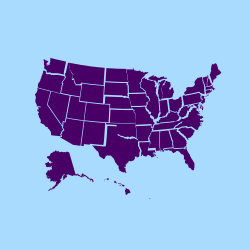
The CivxNow team conducts an annual scan of state policies impacting civic education. Each year, these results demonstrate progress being made at the state level and serve as a valuable resource for legislators, policymakers, school administrators, advocates, and others. The scan is based on recommendations from the CivxNow State Policy Menu, and verified by each state’s Social Studies Specialist or closest education professional. The State Policy Map allows users to view results for individual states. 

  • The scan asks about requirements for high school and middle school civics. As of this year’s policy scan, 36 states (plus DC) now require civics course time in high school in order to graduate. The number of states requiring civics in middle school remained unchanged from last year, with only five states requiring such a course through state statute. It’s important to note that most states establish middle school course time requirements through state learning standards. 
  • A civics assessment is required in 29 states. While that total number remained unchanged from the prior policy scan, the mix of states is different, with the requirement being repealed or established in various states over the past year. 
  • The most recent scan shows 17 states with programs that recognize excellence in civics among students and/or schools—an increase of 3 states since last year. 
  • The total number of states that provide credit for service-learning opportunities decreased by 1 in 2025, to a total of 39 states (plus DC), with an adjustment being made for Nevada, which does not offer credit to students for service-learning experiences, but instead requires such experiences to earn the state’s Seal of Civics. 
  • In 2025, 16 state legislatures appropriated specific funds for K–12 civic education, including curriculum development, resources, and/or professional development for civics teachers. 
  • Civics-related professional development for educators was offered in 44 states (plus DC), up from 36 in 2024. Professional development can be offered in a variety of ways, whether directly from the state’s Department of Education or through grants or third-party partnerships with nonprofit organizations.

August 2025

Last month, CivxNow partner Leadership Ohio released Join In: Revitalizing Civic Life. The report recommends Ohioans rebuild interpersonal relationships and communities through the foundational democratic pillar as old as the republic: joining together. While rooted in the Buckeye State, the report’s findings and recommendations can be generalized more broadly, inviting people to rebuild trust, strengthen democracy, and contribute to the common good through volunteerism and organizational membership.

Leadership Ohio’s Join In tour across the state found that people are spending less time with one another than ever before, stymieing opportunities to connect across differences and weakening social trust. Despite these challenges, Join In found signs of civic renewal and offers a series of recommendations to individuals and families, local businesses, philanthropic organizations, cities, and educators and schools.

Among the highlights for educators and schools are service-learning integrated across the curriculum; extracurricular activities to develop civic skills and earn civic seals; and opening schools to the larger community to host town hall meetings, cultural events, and polling stations on Election Day.

America’s 250th: More Than a Celebration; A Call to Action

Welcome to the 250th anniversary of the Declaration of Independence, the celebration of a relatively young nation, but still the world’s oldest democracy. As we look into our crystal ball to predict the future, we know one thing for certain: July 4, 2026 will bring massive fireworks and the presentation of tall ships. Everything else is a bit hazy, but we, the members of the civic learning field, have a central role to play in preparing young people, and all of us, to write a positive script for the next 250 years of the American experiment.

Consider this reality: A student entering kindergarten this year will graduate high school when this nation celebrates the 250th anniversary of the U.S. Constitution. In a nation where large portions of the public support the Constitution, but can’t name all three branches of government, what will we have done as a field to educate and empower that kindergartner in the coming years to ensure that when they complete high school they are informed and empowered to keep our constitutional democracy vibrant, strong, and secure? In kicking off this year, what can you do to build that brighter future? 

  • Join and promote a campaign: There are many possibilities, but two you might consider are America’s 100 Docs, led by the National Archives Foundation, and the Civic Star Challenge for teachers, led by iCivics and the Bill of Rights Institute. Fun contests with prizes can help bring this moment to life in a classroom near you.
  • Encourage your state America 250 Commission to center civic learning: Each state commission will have its own program and priorities for the coming year. Ensure that they center young people and civic learning in those plans. 
  • Advocate to your elected officials: During the August recess, meet with your elected officials and ask them to use this moment to make a generational investment in America’s youth and their civic learning. (Contact Abbie Kaplan for more information.)

Democracy requires active participation. Let’s ensure that civic learning is America’s learning, this year and beyond. 

A Renewed Commitment to American Civics: State-Led Initiatives Gain Momentum

A notable trend is emerging across the U.S. as state legislatures increased their focus on strengthening civic education this Spring legislative session. Since 2021, 26 states have adopted 42 policies aligned with the CivxNow State Policy Menu, our framework for strengthening civic learning. The momentum continues this year, with 45 states considering 198 bills related to K–12 civic education. Of these, 145 (73%) are aligned with the policy menu, signaling a bipartisan consensus that civic education is a priority in states. 

Recent Legislative Successes in Civic Education

Several states recently enacted significant legislation to reinforce the importance of civics:

  • Utah: Governor Cox signed H.B. 381 into law, which he described as one of the most important bills of the session. The legislation amends high school graduation requirements to include a year-long course on American constitutional government and citizenship.
  • Missouri: Demonstrating a consistent commitment, the Missouri legislature renewed its $500,000 appropriation for professional development in civics and patriotism for the third consecutive year.
  • Louisiana: An initiative championed by State Superintendent of Education Cade Brumley will create a special “Freedom Seal” for graduating students’ diplomas. The seal is designed to incentivize and recognize achievement in learning U.S. history and understanding the political process.
  • Alabama: A new appropriation of $1,500,000 will develop an online course in U.S. history, government, and/or civics. This resource will be available to all pre-K–12 teachers to support instruction aligned with the Alabama Course of Study.

Pending Legislation and Budgetary Considerations

As of the writing of this newsletter, important work continues through the legislative and budgetary process in Massachusetts, Michigan, and Ohio. 

Upcoming Policy and Educational Events

Our focus now turns to building momentum and support for the next session with several key fall events in Colorado and Ohio. Additionally, the Missouri Civic Learning Coalition and the Missouri Historical Society will host a civic education event focused on pluralism on September 30 at the Missouri History Museum in St. Louis. In Kansas, CivxNow will co-sponsor a youth-centered civic summit at Washburn University on November 4 and 5, led by the Kansas Volunteer Commission and friends at the Dole Institute.

Strong Showing for CivxNow During Inaugural Hill Day

Last Thursday, the CivxNow Coalition hosted its first-ever Hill Day in the nation’s Capital. Fifty civic learning advocates visited 40 congressional offices to make the case for sustainable, and ultimately, a generational investment in K–12 students’ civic development. A bipartisan cohort of Congresspeople and Senators graciously received our hopeful message during these perilous, polarized times.

Our group of students, educators, veterans, and community partners visited members of key congressional appropriations committees and respective state delegations. At stake is the current $23M annual investment in American History and Civics National Activities and Academies for the coming fiscal year (2026) that begins in October.

CivxNow members spoke to the impact of these investments, touching an estimated 4,000 teachers and 400,000 students. They expressed how a modest increase in funding would further scale civic learning opportunities for students and professional development for their teachers.

On the horizon next July is the 250th anniversary of this great nation, a clarion call for policymakers to transcend fireworks and tall ships in commemoration and ensure that our youngest Americans graduate with an understanding of the rights and responsibilities of American democracy.

Kindergartners entering school this fall represent the Class of 2038, our next civic milestone when the U.S. Constitution turns 250. Can we guarantee that they will graduate with a deep understanding of the Declaration of Independence, a document longtime civics supporter Jack Miller likens to our national mission statement? Similarly, the Constitution is our longstanding strategic plan for governance. Imperfect, yet alterable by design, it is imperative that our youngest citizens understand the separate and shared powers across our three branches of government, the amendment process, and the Bill of Rights addendum as a condition of state ratification.

Depressing statistics of poor civic knowledge represent a self-fulfilling prophecy given civics’ marginalization in schools and paltry public investments, including less than 50 cents per student at the federal level. We can and must do better for our national posterity.

The CivxNow Coalition put its best foot forward last week in the Capital, doing civics for civics. After all, our students, teachers, and practitioners are the on-the-ground experts of effective civic learning practices and how our schools, districts, and communities stand to benefit from additional federal investment. We are deeply grateful for our partners who came from near and far to take part in this inaugural effort, sharing their authentic insights of the life-changing impact of civics in districts and states.

For most of us, entering the ornate congressional office buildings with staffers and members dressed in fancy suits is very intimidating. Add the fact that our field is resource-starved, and we present little more than the power of our stories and the vast constituencies we represent. But these offices belong to us as citizens. A plaque I encountered upon entering the office of Congressman Raja Krishnamoorthi affirmed this principle: “This office belongs to the people of the 8th Congressional District of Illinois.”

We delivered a civics lesson of our own during the first ever CivxNow Hill Day: The Declaration of Independence is our birthright, and the Constitution a compact of democratic governance with “We the People.” Congress must ensure that the rising generation proudly takes this baton at America250 and works within our institutional frameworks to “build a more perfect union.”

Meeting the Moment, Celebrating Civics Teachers

As we head into Teacher Appreciation Week (May 5–9), we salute civics teachers of all stripes who are doing their very best to educate students for democracy during these tumultuous political times.

The CivxNow Coalition honors their service by amplifying the critical work of civics teachers and students and by doubling down on our commitment to strengthening K–12 civic education policies at the local, state, and national levels.

CivxNow is meeting this moment through a five-point plan:

  1. Growing federal funding for K–12 civics, currently valued at less than 50 cents per student, and seeking a generational investment in students’ civic development to commemorate the 250th anniversary of the signing of the Declaration of Independence. This includes making Fiscal Year 2026 (FY26) appropriations requests to individual congressional offices, a Coalition-wide sign-on letter for FY26, and our first-ever Hill Day next month on May 22. Contact our federal policy lead Abbie Kaplan for further details.
  2. Leveraging numerous state-based opportunities to strengthen civic education in partnership with our state affiliates. Since 2021, 26 states have adopted 42 policies to strengthen civic learning aligned with our State Policy Menu. This year, 44 states are considering 181 bills impacting K–12 civic education. 132 (72.9%) of them align with the policy menu.
  3. Making an affirmative case for civics by further activating the coalition for partnership at the local and state levels. This entails a relentless PR campaign, including a strong social media presence, and sharing consistent insights on coordinated messaging among coalition partners.
  4. Driving national coalition collaboration around key milestones, including Civic Learning Week in March, Civic Season this summer, Constitution Day in September, and Veterans Day in November.
  5. Strengthening the ways we work together. While CivxNow serves as the backbone of the civic learning field, we seek collective impact. This entails elevating the work of coalition partners who are meeting the moment in related issue areas, including libraries, cultural institutions, state humanities councils, and the nonprofit sector more broadly.

This collective work is producing results that will soon yield classroom impact. For example, bills already signed into law this spring in Utah to extend the current one-semester civics course requirement to a full year and in Virginia incorporating media literacy into state standards. 

Moreover, Louisiana just became the twelfth state to adopt civic seals, in this case through administrative action by the Department of Education. Other wins are sure to follow prior to legislatures adjourning for the summer. And progress will continue as the calendar turns to 2026 and we celebrate the 250th anniversary of the signing of the Declaration of Independence.

In the Spirit of 1776, with Teacher Appreciation Week beckoning, we are excited to announce our ambitious goal to recruit 250 teachers from all 50 states and DC to join our Teachers Advancing Civic Learning (TACL) cohort, where we train and empower educators to “do civics for civics.” Teachers are our nation’s most trusted messengers and can speak firsthand to what’s needed in the classroom for students when it comes to civics. Join more than 30 CivxNow partner organizations in sharing this opportunity within your teacher networks as we advance and strengthen civic learning through policy at the local, state, and national levels.

Continuing the Momentum of Civic Learning Week 2025

In an era where everything and everyone seems deeply polarized, how does a field maintain its sense of positivity, integrity, and viewpoint diversity? That was the high bar we set for this year’s Civic Learning Week, and we are proud to say the field rose to and far exceeded it. There were many ways we emerged successfully that can be instructive for our path ahead:

  • We showed rather than told. Our field is viewpoint diverse and believes in the power of institutions and civic learning. During Civic Learning Week we didn’t just say that, we showed it. Organizations across and outside the political spectrum highlighted this commitment to young people, pluralism, and the importance of universal access to civic learning.  
  • We saw and appreciated educators. As a field, we believe that educators play an indispensable role as stewards and protectors of our constitutional democracy. Educators played a core role in the success of the week, leading activities in all 50 states. During Civic Learning Week our partners continued to thank our educators—from classroom teachers and Girl Scout troop leaders to museum educators and the many others on the frontlines instructing young people.
  • We elevated student voices and agency, locally. So many educators engaged young people to solve authentic problems and affect actual decisions locally in their schools and communities. Ultimately, that is the powerful impact of civic learning: It connects people with a sense of place and empowers them to make that place better.

Where do we go from here? We double down on these lessons, find ways to act and build. We cannot rest on our laurels. Let’s take a moment to catch our breath, and then let’s get back on the field because civic learning isn’t just a week, it’s an ongoing movement.

Coming Full Circle for Civic Learning Week

This past week, the Illinois General Assembly adopted Senate Resolution 131, designating the week of March 9-16 Civic Learning Week in the state. 

For me, it’s a proud moment, and one in which my work to date has come full circle. 

Twenty-five years ago last fall, I started my career as a high school social studies teacher in Sheboygan, WI. 

I taught U.S. History and Social Problems (current issues). It might surprise most who know me that I did not teach a civics course. That’s because a standalone civics course was not an option for my students. 

It was nonetheless a formative couple of years as a teacher and coach (football, basketball, and track) before I left to attend graduate school in Chicago and continued teaching at Community High School in West Chicago, IL.

That’s where I started to see the power of civic education.

West Chicago seniors take a required American Government course modeled after the Illinois General Assembly, where parliamentary procedure is employed in class each day while students debate current issues. Students later declare party affiliations, write legislation, and ultimately consider bills in committee hearings and full sessions of the legislature. 

Dubbed the “Legislative Semester,” this experience was formative for me and my students. I fondly recall asking its architect and my mentor, Steve Arnold, why all Illinois graduates didn’t have a similar opportunity. 

He was retiring that spring, and responded, “Shawn, that’s your challenge.”

I left the classroom after four years in West Chicago, but replicated the Legislative Semester in an undergraduate political science course on Congress at the University of Illinois at Chicago and continue to embed current issues discussions in public policy courses to this day. 

Most importantly, I took up Steve’s challenge as Chair of the Illinois Civic Mission Coalition (ICMC) and Director of the Democracy Program during my 16 years at the Robert R. McCormick Foundation in Chicago.

I helped expand the Illinois Democracy Schools Initiative statewide, a school recognition program focused on teaching civics across the curriculum, in extracurricular activities, and through school governance. As of this writing, more than 90 high schools are part of the Illinois Democracy Schools Network and they are representative of the state’s diverse geography and demography.

ICMC advanced a policy agenda beyond Democracy Schools that yielded a legislative task force on civic education, revised state social studies standards centering civic learning, and middle and high school civics course requirements. The spirit of the Legislative Semester is evident in the latter as Illinois civics courses include the usual direct instruction on government institutions, but also discussions of current public issues, service learning, and yes, simulations of democratic processes like lawmaking.

Chicago’s philanthropic community rallied to the cause, supporting teachers, schools, and districts with course implementation as permitted by the new state laws, investing more than $3 million annually in ongoing teacher professional learning opportunities throughout the state. From fall 2015 through spring 2019, the Illinois Civics Hub, led by the incomparable Mary Ellen Daneels, provided nearly 1,200 hours of professional learning to 8,217 teacher participants. 

In turn, teachers emerged with greater knowledge of the new mandates and efficacy in implementing related content and pedagogy in the classroom

Students were the ultimate beneficiaries. 

We’ve found that those taking civics courses are 20% more likely to discuss politics or public issues, 25% more likely to serve as a group leader, and 41% more likely to help make their city or town a better place for people to live. 

Illinois Senate Resolution 131 celebrates this remarkable progress in the Land of Lincoln. Its sponsor, Senator Karina Villa, is fittingly a graduate of Community High School  in West Chicago and a Legislative Semester alum.

Four years ago I joined iCivics to stand up a policy team and scale the now 365-organization-strong CivxNow coalition

During this time, we quadrupled federal funding for K-12 civics.

But it’s on the state level where we have made the most progress, and where we will need to focus in the coming years.

In partnership with state coalitions, CivxNow pushed for adoption of 38 policies in 24 states to strengthen K-12 civic education. This momentum carries forth this spring, with 38 states considering 131 bills concerning civic education, 95 of which are aligned with the CivxNow State Policy Menu.

One of these bills, Assembly Bill (AB) 4 in Wisconsin, sponsored by Representative Amanda Nedweski, would require a semester of civics in high school.  In recent weeks, back where my journey began, I’ve facilitated bipartisan and bicameral conversations about the bill as it makes its way through first the Assembly, and now the Senate. 

One meeting in particular with freshman Representative Joe Sheehan stands out, as he was Superintendent of Sheboygan Area School District when I was a rookie social studies teacher. Then-Superintendent Sheehan supported the adoption of a required civics course at Sheboygan South High School. Now Rep. Sheehan is committed to getting to yes on AB 4, ensuring that the Badger State joins the ranks of 35 others that require a civics course to graduate, and that schools have the requisite resources to implement it with fidelity.

As our third annual national Civic Learning Week dawns on the Wisconsin Capitol in Madison and chambers across the country, we have much to celebrate as a field, and crucial opportunities like AB 4 to further our noble cause.


A Celebration of Civic Education and Its Impact on the Future of Our Nation

With a backdrop of intense change directly impacting the field of civic learning, and more likely on its way, the third annual national Civic Learning Week assumes even greater importance. Throughout the week of March 10–14, we will elevate a shared vision and make a resounding affirmative case for the importance of civic learning in preparing our citizenry for informed self-governance. As public trust in institutions and one another wanes, civics stands as the bedrock of our constitutional democracy and the key ingredient to restore the ties that bind us as Americans.Join the Civic Learning Week celebration by:

  1. Bringing attention to the importance of civic education as a nationwide priority. Use our educator toolkit and/or organization/influencer toolkit to help bring Civic Learning Week to your community.
  2. Thanking educators who embody the best of civic learning. Use this resource template to show support for a “civic learning allstar,” affirming teachers preparing the next generation for their civic roles.
  3. Sharing the importance of civics on social media and/or what civics means to you on the Civic Learning Week platform.

Nearly 250 years ago, the framers of the Declaration of Independence signed their names to an unknown national, much less personal, fate. The sustenance of this experiment in self-governance speaks to their timeless wisdom and to generations of Americans committed to the lofty ideals of “liberty and justice for all.”

Will we answer the call for the rising generation of Americans? Now, more than ever, we must make the case for stronger local, state, and national investments in civics. National Civic Learning Week is our moment to thank frontline educators, emphasize local programs, and highlight positive stories of civic learning’s generational impact. Join us in this urgent cause as we mobilize strong public support for comprehensive K–12 civic education.

  • The American Revolution and Civic Learning: A Conversation with Filmmaker Ken Burns, PBS LearningMedia, and iCivics
    • Wednesday, March 12
    • Join award-winning filmmakers Ken Burns and Sarah Botstein on March 12 at 7:00 p.m. ET for a special conversation on the upcoming documentary series, THE AMERICAN REVOLUTION. Burns and Botstein will discuss with teachers how film and video can bring fresh insight to our founding story and how civic learning can come alive for students in the classroom. Register today!
  • Featured Conversation with Sonia Sotomayor, Associate Justice, Supreme Court of the United States
    • Friday, March 14
    • Students will join Justice Sotomayor in a discussion about civic education on March 14 at 1:00 p.m. ET. Register today!

Explore Civic Learning Week Events!