Dec 2025: Our 2025 Impact: Celebrating Wins and Planning the Road Ahead

News From the Front Lines of Civic Education

Crucial March Toward Stronger Civic Education Continued in 2025

This year, we continued our crucial march to strengthen K–12 civic learning from coast to coast.

Through the strength of our coalition, which now stands at over 400 members, we celebrated educators, elevated teacher voices in Washington, D.C., and ensured civic learning is central to the planning for the nation’s 250th.

Plan Your Civic Learning Week Involvement

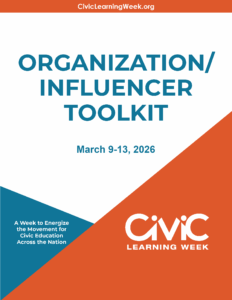
Use the Organization/Influencer Toolkit to access resources to help you plan and communicate your participation in Civic Learning Week 2026.

The toolkit includes planning resources, tips for engaging youth voice, sample social media posts, graphic assets, sample emails and press materials, and more.

Research Roundup: Hoover Institution Completes Civic Learning Landscape Analysis

Last month, the Hoover Institution published a comprehensive landscape analysis of The American Civic Education System.
 
The report documents that the marginalization of civic learning is generational and that efforts to scale solutions often lack coherence. Key observations stress that political polarization must be mitigated, and that educators require more in-person professional development.
pie chart icon

On the Road

Hill Day picture of participants behind podium
Photo of Hill Day participants in Congressional office

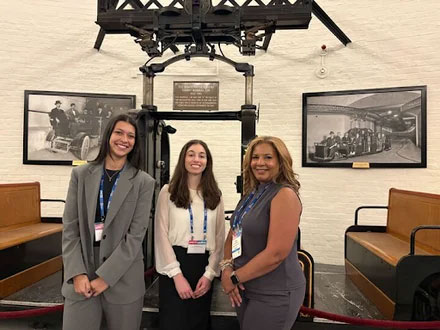
State Policy Lead Andrea Benites and Policy Associate Sydney Moore attended the 105th National Council for the Social Studies (NCSS) Annual Conference in Washington, D.C.

The conference featured a powerful Hill Day where the team supported teachers in advocating for increased investment in civics education on Capitol Hill. Energizing keynote sessions left a lasting impression on the CivxNow team.

In the News

Winter Break reading:

  • NPR takes a look at a long-running moot court contest in NYC that teaches high school students how government works.
  • iCivics CEO Louise Dubé and Chief Education Officer Emma Humphries penned a piece for AllSides about why we must continue to teach hard topics.
  • James Traub asks if we could pass the updated naturalization civics test in this op-ed in The New York Times.
  • Wisconsin Watch explains how a retiree’s passion for local office sparked a statewide high school civics contest.

New Members

CivxNow continues to grow, now officially standing at more than 400 member organizations! The latest additions are: We remain deeply appreciative of member efforts and all that we accomplish together. Our goal is to aggregate and activate large networks of support to expand and re-imagine civic education as a force for civic strength. To our members, thank you for your partnership. If your organization is interested in joining CivxNow or in learning more, please contact us at CivxNow@icivics.org.

Related Posts

February 2026

Forty-seven percent of young voters (ages 18–29) cast ballots in 2024, down three points from 2020, but eclipsing 2016 turnout

Read More

Crucial March Toward Stronger Civic Education Continued in 2025

Amidst a turbulent year for our country, the CivxNow Coalition continued its crucial march to strengthen K–12 civic learning from coast to coast.

Back in January, we challenged newly sworn-in federal leaders to strengthen investments in civic education, and Congress responded by maintaining appropriations for American History and Civics Academies and National Activities at $23M. This fall, the Trump Administration increased this investment to $153M over three years with grants to higher education institutions and nonprofits in celebration of the upcoming 250th anniversary of the signing of the Declaration of Independence.

In May and December, the CivxNow policy team led and was part of two Hill Day efforts, where dozens of teachers, students, nonprofit leaders, and veterans made the case for civic learning among congressional offices. With our partners at the National Council for the Social Studies, 50 teachers from 24 states facilitated impactful meetings with their U.S. Senators and Representatives, ensuring that classroom voices are elevated in our nation’s capital during this challenging time for educators.

Turning to states, there is clear momentum for stronger civic learning policies, with 195 civics-related bills in 45 states, and 145 of them (73%) aligning with the CivxNow State Policy Menu. Several made it across the finish line, including Louisiana’s adoption of civics diploma seals; Ohio’s $500,000 appropriation for curriculum development at the intersection of civics and literacy; and a Utah law extending its high school course requirement from a semester to a full year.

Since 2021, by our count, 33 states have adopted at least 50 policies strengthening K–12 civic education. And thanks to the work of our state affiliates, a plethora of states are poised to move legislation expanding course requirements, civics appropriations, civic seals, and information literacy in the new year. These gains are delivering demonstrable impact: In the 12 states with new or expanded civics course requirements since 2018, we estimate that 700,000 additional students benefit each year through dedicated instruction in civics.

The collective impact documented above is attributable to our now 400-member-strong coalition and nearly 50-state-plus-D.C. representation on our State Policy Task Force. This fall we orchestrated impactful stakeholder events in Columbus, OH; Denver, CO; and St. Louis, MO. We’ve also convened a “State America 250 Commission K–12 Youth Coordinating Working Group” with a goal of ensuring that civic learning is central to next year’s semiquincentennial celebrations and commemorations.

We took the Civic Learning Week National Forum to the West Coast back in March, partnering with the Hoover Institution at Stanford University to reach new geographic and ideological audiences. Beyond the National Forum, our partners hosted events in all 50 states, celebrated teachers, and elevated student voice in making the case for universal access to high-quality K–12 civic learning. We hope to see many of you in Philadelphia this coming March for the next National Forum, and encourage each of your organizations to participate in the weeklong national celebration during the nation’s 250th.

Before signing off for the year, I’d like to recognize the members of the policy team who make this work possible:

  • Ace Parsi has more than doubled the size of CivxNow since taking the reins and has achieved near universal participation among members in our collective impact efforts.
  • Abbie Kaplan was the architect of the aforementioned Hill days and the captain of our federal policy campaign, engaging partners and educators in our federal policy and advocacy activities.
  • Diana Leo is building a strong coalition presence in the Southwest and helped deliver the important policy win in Utah.
  • Andrea Benites moved seamlessly from policy coordinator to state lead in the Mid-Atlantic region. Previously, she led the last two state policy scans and meticulously tracked civics bills on a weekly basis throughout the year.
  • Sydney Moore joined the team as policy associate after previously serving as an intern supporting coalition engagement work.
  • Dave Buchanan continued his two-hatted role as Massachusetts coalition leader and professional learning provider, repeatedly securing the largest annual state appropriation for K–12 civic education in the country.
  • And we sadly bid farewell to Lisa Boudreau and Tanisha Pruitt this year. Lisa quarterbacked great successes at the state level since 2022, and Tanisha began building our focused policy campaigns in the Midwest. We pledge to carry their work forward with aplomb.

Our team is eternally grateful for your partnership, collegiality, and friendship as we collectively carry the banner for stronger K–12 civic education as a bulwark for our constitutional democracy. We wish you and yours the happiest of holidays and look forward to the promise of the new year, our nation’s 250th. See you in 2026!

December 2025

Last month, our partners at the Center for Revitalizing American Institutions (RAI) at the Hoover Institution published a landscape analysis of The American Civic Education System. Based on an extensive literature review, individual interviews and focus groups, and a survey of educators and students, RAI documented three broad trends all too familiar to the civic learning field:

  1. The marginalization of civic learning is generational in nature;
  2. Civic learning is vital to the strength and sustenance of our constitutional democracy and transcends ideological divides; and
  3. While the civic learning field has rallied to meet the challenge of the moment, our efforts often lack coherence and we struggle to scale them across our P-20 system.

The report proceeds to make more specific observations, several of which bear repeating:

  • While tensions between liberty and democracy are inherent to our system, toxic political polarization is not and must be mitigated;
  • Civic learning must be taught as a stand-alone subject across grade bands, but also integrated across subject areas to ensure greater emphasis;
  • There is no shortage of civics curricula and resources, but there are a dearth of materials focused on international relations, military, and national security;
  • Civic learning is excessively siloed within K–12, higher education, and civil society; and
  • Educators want greater access to in person professional development opportunities where they engage with subject matter experts and learn from one another in community.

The authors conclude by recognizing the role for bridge-building leaders and institutions given the aforementioned challenges, one that the CivxNow coalition aspires to play with its 400-plus, pluralistic members in partnership with RAI. This report is an important contribution to our collective work to strengthen our P-20 civic education system.