Nov 2025: Civic Education This Season: Bridge Divides and A250 Prep

News From the Front Lines of Civic Education

Civic Education This Thanksgiving

This season, we look beyond the tradition of turkey hats to focus on the civic learning field’s deeper purpose: building young people’s capacity to navigate complexity and bridge divides.

We invite you to engage in three essential actions that elevate educators and strengthen classroom conversations. 

Civic Learning Week National Forum

Registration is now open for the 2026 Civic Learning Week National Forum, Liberty and Learning: Civic Education at 250.

Hosted by iCivics and the Democratic Knowledge Project, the forum will be held March 9–10, 2026 at the Loews Philadelphia Hotel. We will explore key topics related to the importance of liberty and learning, what that looks like in practice, and the leadership needed to make high-quality civic education a nationwide priority.
Liberty and Learning: Civic Education at 250 Civic Learning Week National Forum logo with stylized book people and star

Book Review: Reclaiming Patriotism in an Age of Extremes

As the United States prepares for the 250th anniversary of its Declaration of Independence (A250) in July, Steven Smith’s Reclaiming Patriotism in an Age of Extremes explores the true meaning of patriotism.

Smith defines patriotism as a form of loyalty and a “learned disposition” which is the very component of an educated mind, making the seeking of knowledge and understanding a powerful act of patriotism for A250. 

On the Road

Colorado Civic Readiness for All

Leaders from education, policy, and community sectors gathered in Denver on Nov. 4 to leverage the upcoming 150th anniversary of Colorado’s statehood (CO150) and A250 commemorations through partnerships to ignite civic engagement.
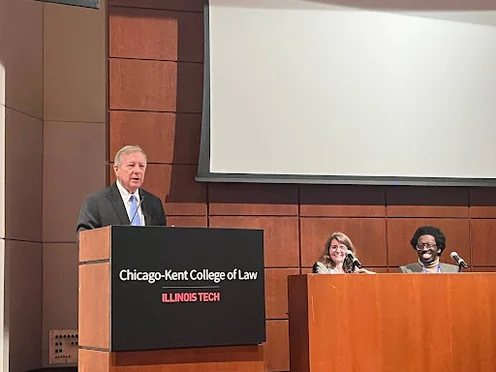
Speakers on stage

The Constitutional Democracy Project

The Constitutional Democracy Project held its annual conference for civics teachers on Oct. 31, featuring a surprise appearance by Illinois Senator Dick Durbin, a longtime supporter of civics and history education.

In the News

Civics in the news as we head into Thanksgiving:

  • NPR spoke to a number of CivxNow partners in this piece about the $150 million in grants that just went to civic education.
  • Rick Hess discusses “real-world civic education” in this piece in Education Next.
  • Jeffrey Edward Green writes that civic education should challenge students in this Boston Globe piece.
  • U.S. Supreme Court Justice Neil Gorsuch told a local Fox network that lack of civic education is our country’s biggest problem—and he’s following a trend of Justices who have written children’s books. 

New Members

CivxNow continues to grow, now officially standing at more than 400 member organizations! The latest additions are: We remain deeply appreciative of member efforts and all that we accomplish together. Our goal is to aggregate and activate large networks of support to expand and re-imagine civic education as a force for civic strength. To our members, thank you for your partnership. If your organization is interested in joining CivxNow or in learning more, please contact us at CivxNow@icivics.org.

Related Posts

February 2026

Forty-seven percent of young voters (ages 18–29) cast ballots in 2024, down three points from 2020, but eclipsing 2016 turnout

Read More

Civic Education This Thanksgiving

When we think about Thanksgiving in the K–12 context, it’s hard not to picture turkey hats, gratitude worksheets, and children’s books about the story of Thanksgiving. For the civic learning field, this season calls us to think more deeply and build young people’s capacity to develop skills to bridge divides. To that end, in this Thanksgiving iteration of our newsletter, we invite you to:

  • Be public in your gratitude for teachers and schools. Appreciation is as core to Thanksgiving as turkey and stuffing. We invite you and your organization to use these templates to thank a few specific civic teachers and schools you work with. Appreciation is about helping people feel seen, and there is no better time to elevate these essential professionals and institutions than now.
  • Lean into the full range of lessons. In celebrating Thanksgiving, we must note that in many communities— particularly Native American communities—this can be challenging. We may be motivated to lean away from the complexities of the holiday season, but as iCivics Chief Education Officer Emma Humphries encouraged us recently, we can teach hard things—and we should. When we do, we give our young people more tools to navigate tough conversations. Get started with some lessons from our coalition partner, C-SPAN.
  • Teach to bridge divides. During a time of “lamentable civil strife,” President Lincoln’s 1863 Thanksgiving Proclamation recognized many bounties and looked to “peace, harmony, tranquility, and Union.” This is the great challenge of the Thanksgiving table: holding multiple, sometimes competing, ideas in tension and getting family and friends of divergent views and experiences to meaningfully listen and navigate differences. Check out these partner resources for bridging activities.

So happy Thanksgiving! Thank you for your work, enjoy time with your friends and family, and let’s live our time moving forward with gratitude and boldness.

November 2025

Patriotism is in the air as the United States prepares for the 250th anniversary of its Declaration of Independence in July. Yet the true meaning of patriotism and how to cultivate it among citizens is a matter of fierce debate. Steven Smith attempts to bridge current ideological chasms and offer a unifying brand of American patriotism in his 2021 book Reclaiming Patriotism in an Age of Extremes (Yale University Press).

The United States, from its inception, was a “creedal nation,” meaning that being an American meant adherence to a set of core beliefs: equality, individual rights, liberty, and limited government, among them. This is juxtaposed with an ascendant nationalism on the political right, and a cosmopolitan, or “citizens of the world” concept, prevalent on the left. Smith attempts to reclaim patriotism from these poles in this fraught political moment.

The author defines patriotism as “a form of loyalty to…one’s constitution or political regime.” American patriotism is aspirational: “To be an American is to be continually engaged in asking what it means to be an American.”

Moreover, patriotism, Smith writes, is a “learned disposition” as opposed to indoctrination. Instead, it is a “component of an educated mind.” In this sense, one of the strongest acts of patriotism we can all engage in for A250 is simply the learning and the seeking of knowledge and understanding of history and civics. 

Smith compares the Declaration of Independence and Constitution with core religious texts: the former emphasizes individual rights, while the latter establishes self-government through federalism. These seminal documents breed a form of “civic faith,” what Lincoln called the “political religion of the nation.”

We are therefore a textual people, participants in ongoing debates over the true meaning of our creed. These debates are core to American patriotism and its enlightened form that Smith elevates as the root of what makes America exceptional.

In this year of the semiquincentennial, may the teaching of American virtues, namely civility, rule of law, mutual respect, responsibility, and leadership, among others, flourish in our K–12 classrooms and cultural institutions as we pass along this precious birthright to our posterity.