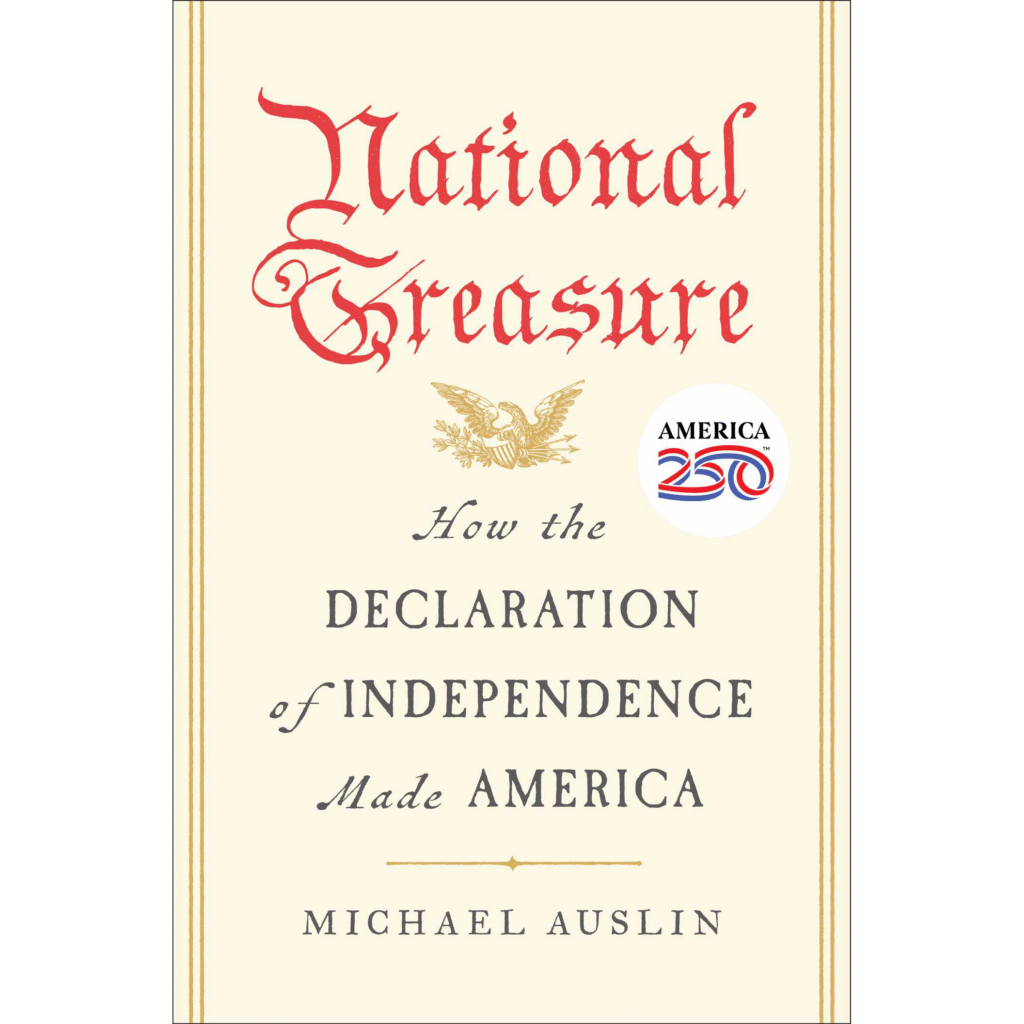
Twenty years ago, as resident scholar at the McCormick Foundation’s Freedom Museum, I guarded a Dunlap Broadside of the Declaration of Independence on opening night, ensuring its safety from guests’ refreshments. Only 21 known Dunlap copies exist of what was the first public pronouncement of American independence, and this was my first encounter with the Declaration’s sacred lineage. The broader 250-year journey of the original document and its many reproductions and debates over its meaning are the subject of author Michael Auslin’s timely new book, National Treasure: How the Declaration of Independence Made America.
Auslin begins with the series of events that led to the Continental Congress assembling in Philadelphia and delegating the task of authoring the Declaration to Thomas Jefferson, John Adams, and Benjamin Franklin, among others. Adams was arguably the strongest political force for independence, but he acknowledged that Jefferson was both a better writer and situated strategically in Virginia.
The vote for independence actually occurred on July 2, but the final wording of the Declaration of Independence was formally adopted two days later on July 4. Jefferson was undeniably the lead writer, but 25% of his original draft was scrapped, and it reiterated arguments already well-established in the Revolutionary era. Moreover, the infamous signing of the engrossed document did not occur until later in the summer (and beyond, with the final signature not coming until January 1977).
Attention to the Declaration receded as the Revolutionary War ended and the new Republic struggled to govern an increasingly continental nation. This shifted when the United States defeated the British for a second time in the War of 1812. During Great Britain’s burning of Washington, D.C., a well-established myth has First Lady Dolly Madison saving the Declaration on her way out of the soon-to-be renamed White House. While Madison did save a portrait of George Washington, it was State Department employee Stephen Pleasonton who outran the British with the Declaration on his wagon heading out of town, preserving America’s founding document for posterity.
The Civil War was of course the ultimate test of the still fledgling nation. In fact, Jefferson’s condemnation of the slave trade in his first draft of the Declaration was among the passages removed by the larger congressional committee. President Lincoln trumpeted the lofty ideals of the Declaration in his quest to preserve the Union and ultimately end slavery.
A theme throughout Auslin’s tome is how marginalized groups invoked the words of the Declaration to challenge the country to live up to the true meaning of its founding creed. This includes abolitionists like William Lloyd Garrison and Frederick Douglass, the women’s rights advocates of Seneca Falls, and civil rights leaders like Martin Luther King, Jr. The author acknowledges that this struggle is perennial and in part what makes America exceptional.
Since the War of 1812, Americans have yearned to see the Declaration with their own eyes and hold its reproductions in their hands. Modern science continues to make this possible as school groups and tourists line up at the National Archives to see the nation’s sacred texts, the Constitution and Bill of Rights included, and later purchase facsimiles from the gift shop as personal keepsakes.
Auslin’s careful documentation of the Declaration’s provenance is an important contribution to existing scholarship during this seminal year. We are currently writing the next chapter during its semiquincentennial and are compelled to carry the lofty ideals of our birthright forth for generations to come.