Every day, young people are asking big questions and exploring ways to contribute to their communities.
Civic seals celebrate the curiosity, commitment, and leadership students bring as they grow into informed and engaged members of our self‑governing society.
What Are Civic Seals?
A civics class teaches students how constitutional democracy in the United States works. A civic seal proves they’ve practiced it.
A civic seal is a state-recognized credential, created through legislation or state administrative action, that is awarded to individual students for civic learning beyond standard graduation requirements. It may appear on the high school diploma or transcript, or be issued as a certificate by a state agency or other governmental entity.
Most civic seal programs require students to demonstrate competency across three areas:
Civic Knowledge
Understanding how government, law, and democratic institutions work
Experiential Learning
Applying learning through meaningful engagement
Civic Reflection
Articulating what is learned and how it shapes one’s role as a citizen
Specific requirements vary by state, but the core expectation is consistent: students must show they can apply what they’ve learned, not just recall it.
Why Civic Seals?
Civic seals turn civic education from an abstract goal into a concrete, student-level credential.
Real-world application: Students pursuing civic seals demonstrate practical application of what is learned in the classroom.
An incentive, not a requirement: No new graduation mandate, no standardized test. Students opt in. That makes civic seals easier to adopt when budgets are tight and curricula are full.
Real results: Students with a comprehensive civic education complete college at higher rates. They vote. They volunteer. They build stronger communities.
Skills that outlast the diploma: Public speaking. Project management. Group decision-making. Employers and colleges value that students can practically apply what they have learned inside the classroom, which a GPA alone can’t capture.
Built for every student: We know what works: multiple pathways, school-day completion, and tracking from day one make civic seals accessible for all.
Civic Seals in the States
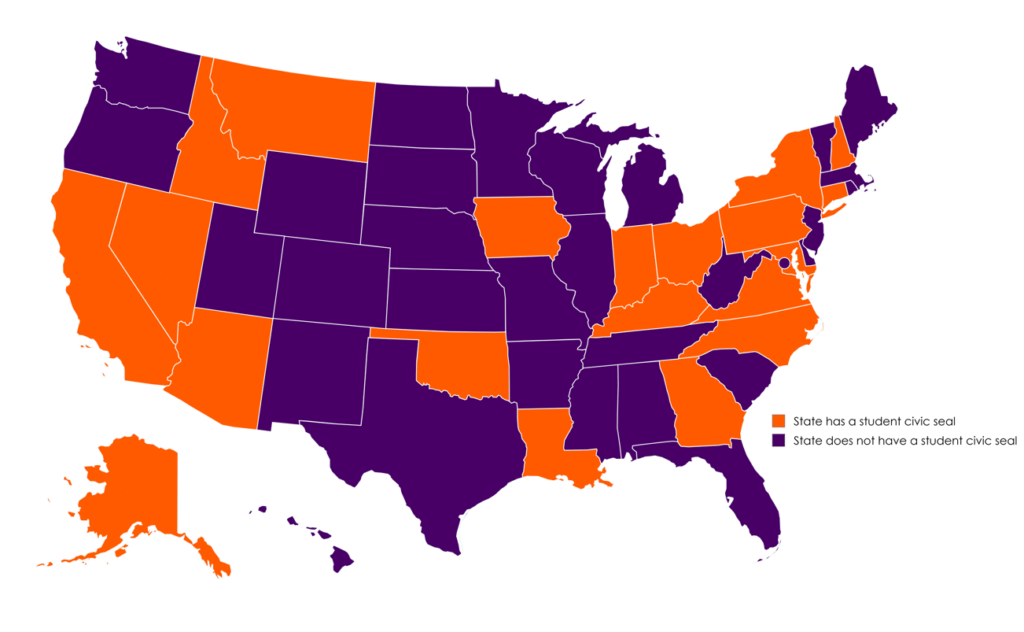
Twenty states have established civic seals, most with bipartisan support. Additional states have recognition at the district, school, and/or teacher level, while several other states are considering civic seal legislation.
Implementation Examples
California
Equity-centered with strong growth data
Multiple pathways to earn the Seal of Civic Engagement: civic action projects, portfolios, or coursework plus community engagement.
Grew from 29 districts to 65 in one year (5,359 seals to 10,104).
The most successful districts designed for school-day completion and included students in program design.
Indiana
Launching in 2029
Public Law 114 established the Excellence in Civic Education distinction with bipartisan support.
Available for students graduating in 2029, paired with a school recognition program, criteria include volunteer work, project-based learning, and coursework, with flexibility for state-level customization.
Kentucky
Grassroots and student-driven
A partnership between the Secretary of State and the Kentucky Civic Education Coalition.
Students design their own civic engagement projects, demonstrate civic knowledge, and reflect on their learning.
Spans entire K-12 continuum, with strong interest at both elementary and high school levels.
New York
Civic readiness as a graduation pathway
Students earn a Seal of Civic Readiness by accumulating six points across Civic Knowledge and Civic Participation categories, with flexibility to build on their strengths.
The seal can substitute for one of five required Regents exams, giving it real weight in the graduation system.
State Policy Options
Seven actions state legislatures and boards of education can take to establish or strengthen civic seal programs:
Establish a civic seal through legislation or executive action, with criteria covering civic knowledge, democratic participation, information literacy, community service, and bridge-building
Ground criteria in research, using the Roadmap to Educating for American Democracy as a foundation
Create multiple pathways so students can earn the seal through coursework, service learning, civic projects, assessments, capstones, and.or portfolios
Build access into the design, including scheduling flexibility, varied assessments, and mentoring support
Fund professional development for teachers, counselors, and administrators on civic engagement pedagogy
Track participation and demographics annually to identify and close participation gaps
Make the credential count beyond the diploma: Think workforce credentials, college recognition, scholarships, and/or post-secondary credit
Get Support
For one-to-one support on advancing civic seal legislation and/or building a coalition in your state, please contact our state policy staff.